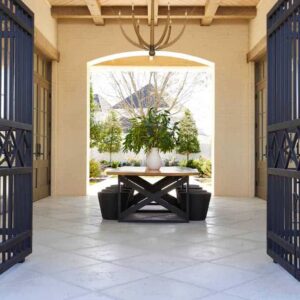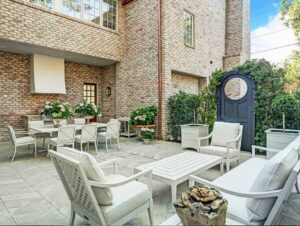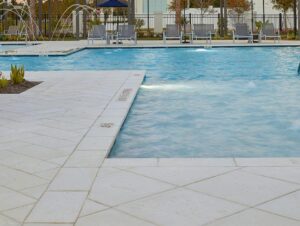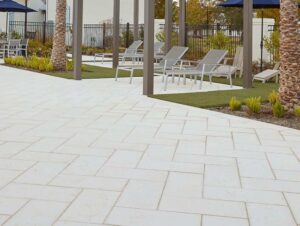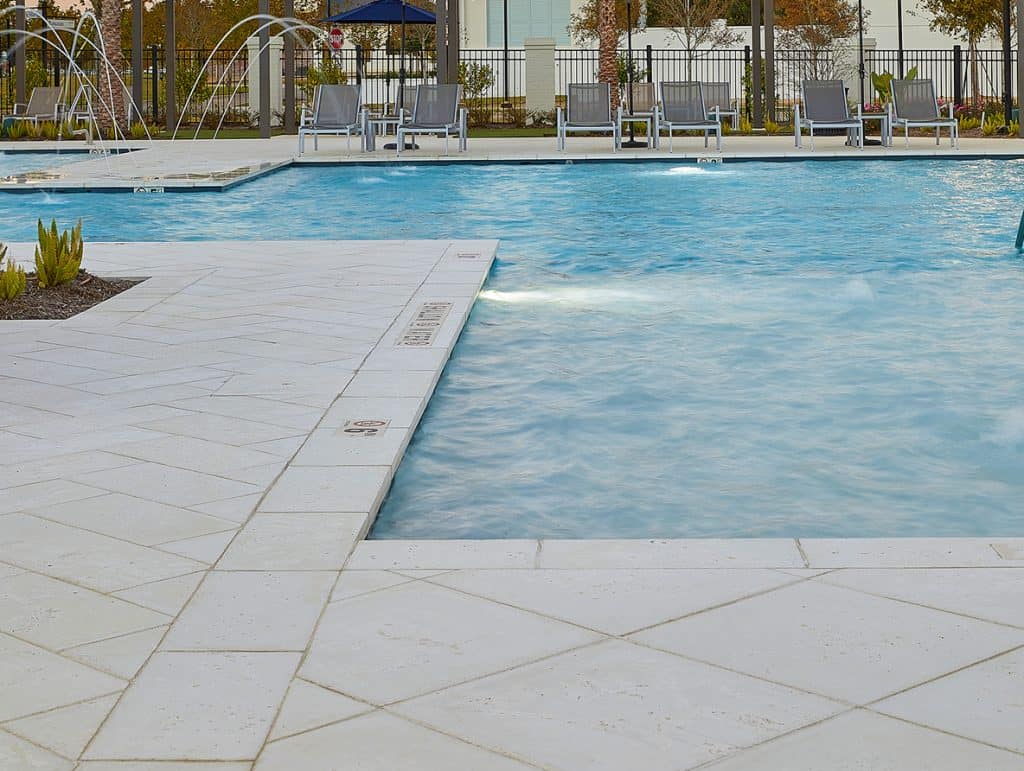
Most of the attention in a pool project goes to the water and the deck. But the piece that ties them together is the narrow band right at the edge: the coping. It’s where people sit with their feet in the water, where kids climb out, and where your eye lands first when you walk outside.
Good coping makes a pool look finished and feel comfortable. Coping that doesn’t suit the deck can make an expensive project look unresolved. Here’s how to choose it well.
What Pool Coping Actually Does
Coping is the cap that sits on top of the pool wall (the bond beam) and forms the border between the water and the deck. It does several jobs at once:
- Protects the pool structure. It covers the top of the wall and helps keep splash water from running down behind the pool shell.
- Directs water away. Coping is set with a slight slope so water runs off toward the deck and its drains, not back into the pool.
- Gives you a safe, comfortable edge. It’s the surface people grab, sit on and push off from, so the edge profile matters.
- Frames the design. Coping is the outline of the pool. Its width, color and edge set the tone for the whole space.
Choosing an Edge Profile
Our coping, stair tread and wall cap pieces come in three edge profiles. Each one changes how the pool feels.
- Bull Nose. A fully rounded edge. It’s the most comfortable profile to sit on and the softest to bump against, which is why it’s a favorite for family pools and steps into the water.
- Eased Edge. A crisp edge with the sharpness taken off. It reads clean and tailored, and suits modern and transitional homes that still want a comfortable touch.
- Straight Edge. A square, architectural edge. It gives a sharp, minimal line that works well with contemporary pools, raised edges and water features.
| Edge profile | The look | Often chosen for |
|---|---|---|
| Bull Nose | Soft, rounded, classic | Family pools, entry steps, sitting edges |
| Eased Edge | Clean with a softened corner | Transitional and modern homes |
| Straight Edge | Crisp, square, architectural | Contemporary pools, raised walls, water features |
If you’re unsure, think about how the pool will be used. A pool where people lounge along the edge leans toward Bull Nose. A pool that’s mostly a design feature can carry a sharper profile. Our article on the benefits of concrete paver trim goes deeper on edge profiles and how trim keeps a paved edge aligned over time.
Sizing Coping to Your Pool
Coping pieces come in a range of sizes, starting at 11½” deep and running in lengths from 11½” up to 29½”. Larger squares (17½”, 23½”, 29½” and 35½”) are available too.
A few guidelines help:
- Narrower coping (11½”) gives a light, tailored border and suits most residential pools.
- Wider coping (17½” and up) creates a generous ledge that reads as a deliberate design feature, and gives more room to sit.
- Match the module. Coping sized to the deck pavers keeps joints lined up, so the edge and the deck read as one design. If your deck uses large squares, coping in the same width usually looks best.
- Curves need planning. Freeform pools use shorter lengths or cut pieces to follow the curve. Talk with your installer about the radius before you order.
Brick Coping for a Traditional Look
For older homes, courtyards and gardens, our Brick Coping (3½” x 11½” x 1¾”, bull-nosed on the 3½” side) brings the look of classic masonry. It’s a lovely choice for raised spa walls, planters and pools surrounded by brick or an Old World style of architecture.
Matching or Contrasting the Deck
All six of our standard colors are available for trim, so you can match the deck exactly or set the edge apart:
- Matching coping and deck, such as Oyster Shell throughout, gives a calm, seamless look that makes the pool feel larger.
- Contrasting coping, such as a Rice White edge against a Champagne or Buff deck, outlines the pool and makes its shape a feature.
- Lighter colors like Rice White and Oyster Shell are a popular choice where bare feet spend a lot of time, since pale surfaces generally stay more comfortable in direct sun than dark ones.
The best test is to see the colors next to your water. Our design tool lets you try colors and patterns in real settings before you decide.
Beyond the Pool Edge: Steps, Spas and Walls
The same pieces used for coping also work as stair treads and wall caps. Using one profile for the pool edge, the steps down to the patio, a raised spa and any seat walls ties the whole outdoor space together. It’s one of the simplest ways to make a pool area look designed rather than assembled.
Details to Discuss With Your Installer
Coping should be installed by a qualified contractor, working with your pool builder. A few points worth raising early:
- Setting method. Coping is commonly mortar-set on the pool wall. Our installation guides cover both mortar-set and sand-set methods.
- Slope and drainage. The coping and deck should shed water away from the pool.
- The joint between coping and deck. This joint needs to allow for movement between the pool structure and the surrounding deck. Your pool builder will know what your pool requires.
- Sealing. Sealing coping and decking helps protect against pool water, sunscreen and everyday stains. See our guide to resealing concrete pavers.
For more on keeping the whole pool area safe underfoot, read 11 Ideas for Making Pool Hardscapes Safe.
Finish the Pool the Right Way
Coping is a small part of the budget and a big part of how the pool looks and feels. Order a sample kit to hold our colors up to your water, explore finished pools in our portfolio, and request a quote when you’re ready to plan the edge, the deck and everything around it.