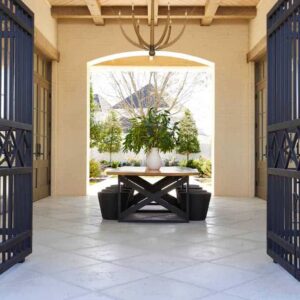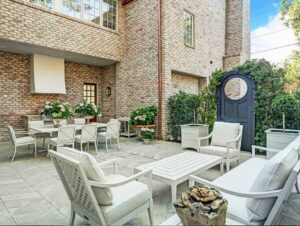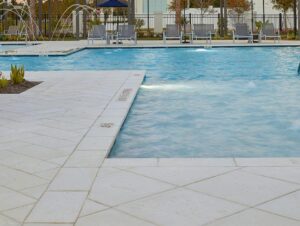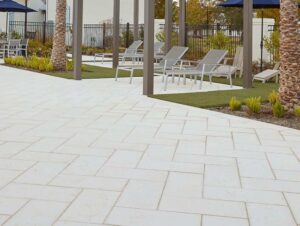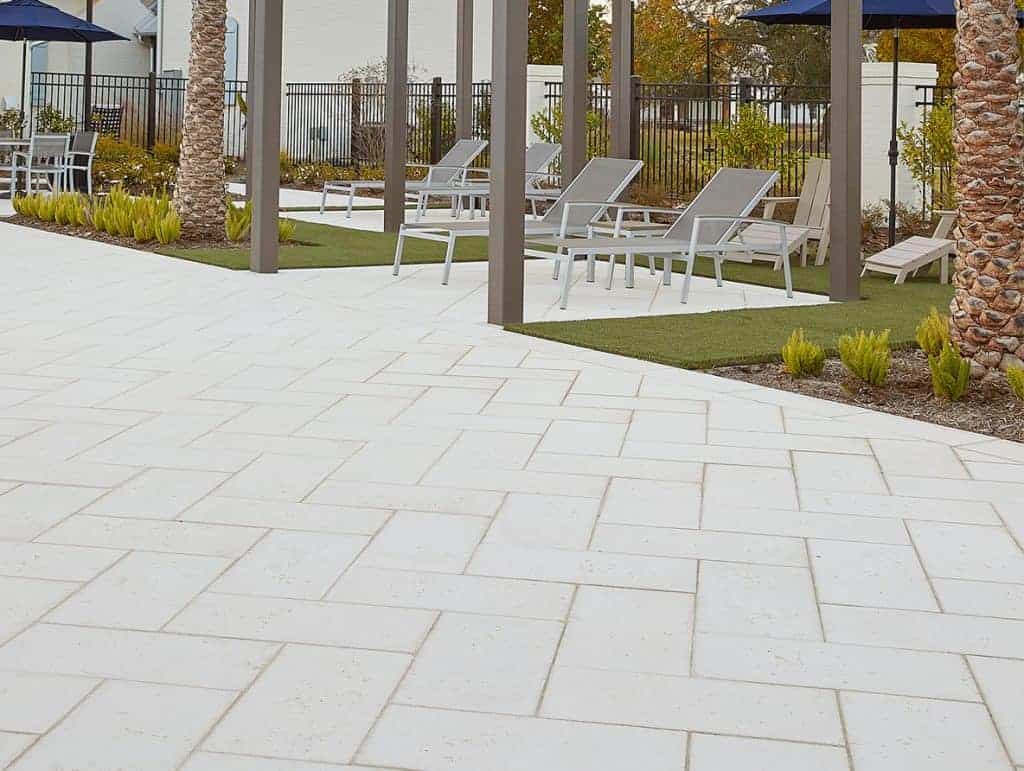
Most people pick a paver color first. Shape usually comes second, and it often gets less thought than it deserves. But shape changes how a space feels more than you might expect. The same color can look calm and modern as large squares, relaxed and classic as rectangles, or full of texture as hexagons.
Shape also affects how much cutting your installer does, how much material you order and, in the end, what the project costs. Here’s how to think about each one.
Square Pavers: Calm, Clean and Easy to Plan
Squares are the simplest shape and one of the most versatile. Laid in a straight grid, they give you an orderly, balanced floor that doesn’t pull attention away from the architecture or the landscaping.
We make squares in five sizes: 11.5″, 17.5″, 23.5″, 29.5″ and 35.5″. Size changes the effect a lot:
- Smaller squares (11.5″ and 17.5″) have more joints, which adds texture and a more traditional feel. They suit smaller patios, paths and interior rooms.
- Larger squares (23.5″ and up) have fewer joints, so the surface reads as one calm plane. That’s why big squares are so common in modern homes and around pools.
Squares are also the easiest shape to lay out. In a straight grid, there’s less cutting at the edges, which can keep labor and waste down. Turn the same squares 45 degrees into a diamond pattern and you get a more formal, classic look, but expect more cuts along the borders.
Best for: modern homes, pool decks, large patios, interiors that flow outside, and anyone who wants a timeless look that won’t feel dated.
Rectangular Pavers: Direction and Movement
Rectangles do something squares don’t: they point. Long pieces lead the eye in the direction they run, which you can use to your advantage.
- Run rectangles lengthwise down a walkway to make it feel longer and draw people toward the door.
- Run them across a narrow patio or hallway to make it feel wider.
Rectangles also open up more patterns. A running bond (offset rows, like brick) feels relaxed and familiar. Herringbone feels lively and a bit more traditional. Mixing rectangles with squares gives you a random or “Versailles-style” look with an Old World feel. Our paver patterns and layout ideas post shows these side by side.
Our rectangles run from 11.5″ x 17.5″ up to 17.5″ x 29.5″. Long, narrow formats like 11.5″ x 29.5″ have a plank-like look that works well in kitchens, porches and long entry paths.
Best for: walkways, driveways, long or narrow spaces, and patterns like running bond and herringbone.
Hexagon Pavers: Texture and Character
Hexagons are the most decorative of the three. The six-sided shape creates a honeycomb pattern that adds texture without needing a second color. Our Classic Hexagon is inspired by historic European paving and looks right at home in older houses, courtyards and entries. The Picket Hexagon is a stretched version with longer proportions. It feels a bit more modern and works well in bathrooms, mudrooms and accent areas.
The tradeoff with hexagons is the edges. Wherever a hexagon floor meets a straight wall, a step or a border, the installer has to cut pieces to fit. That means more labor and more leftover material than a square grid. A common way to handle it is to frame the hexagon area with a border of square or rectangular pavers or trim, so the cut edges land neatly against a straight line.
Because of that, hexagons tend to shine in defined spaces: an entry, a covered porch, a bathroom floor, a courtyard with clear edges. On a large, irregular patio, the cutting adds up.
Best for: entries, courtyards, bathrooms, mudrooms, accent areas and historic or European-style homes.
What About Chevron?
We also make a Chevron paver, which forms a continuous V pattern. It has a lot of energy and works well when you want the floor to be a feature, like a mudroom, a hallway or an outdoor bar area. Like hexagons, chevron needs careful layout at the edges.
How Shape Affects Cost and Ordering
Shape doesn’t change the price of the material as much as it changes the work around it. Here’s what to keep in mind when you budget:
- Cuts. Straight grids of squares or rectangles have the fewest cuts. Diagonal layouts, hexagons and chevrons have the most.
- Extra material. You’ll always order a little more than your square footage to cover cuts and breakage. A common rule of thumb is around 10% extra for straight layouts and more for diagonal or hexagon layouts. Your installer can give you an exact number for your space.
- Labor. More cuts and more careful layout mean more time. Ask your installer to price the shape you’re considering, not just the square footage.
- Future repairs. Keep a few spare pavers from the same order. If one ever needs replacing, you’ll have a matching piece.
Matching Shape to the Space
If you’re stuck, these quick pairings are a good place to start:
| Space | Shapes that tend to work well |
|---|---|
| Pool deck | Large squares or long rectangles |
| Front walkway | Rectangles running toward the door |
| Patio | Squares, or a mix of squares and rectangles |
| Courtyard or entry | Hexagons with a straight border, or a diamond-set square |
| Driveway | Our 3″ thick driveway pavers in rectangles or squares |
| Kitchen or living area | Large squares or plank-style rectangles |
| Bathroom or mudroom | Picket Hexagon or Chevron |
For driveways specifically, shape is only half the question. Thickness matters more. Our paver thickness guide explains which thickness to use where.
See the Shapes Together
Shapes are much easier to judge in person than on a screen. Browse our shapes and size chart, look through completed projects in our portfolio, or order a sample kit to see the finish and color up close. If you’d like help planning a layout, request a quote and our team will walk through it with you.