 |
| 
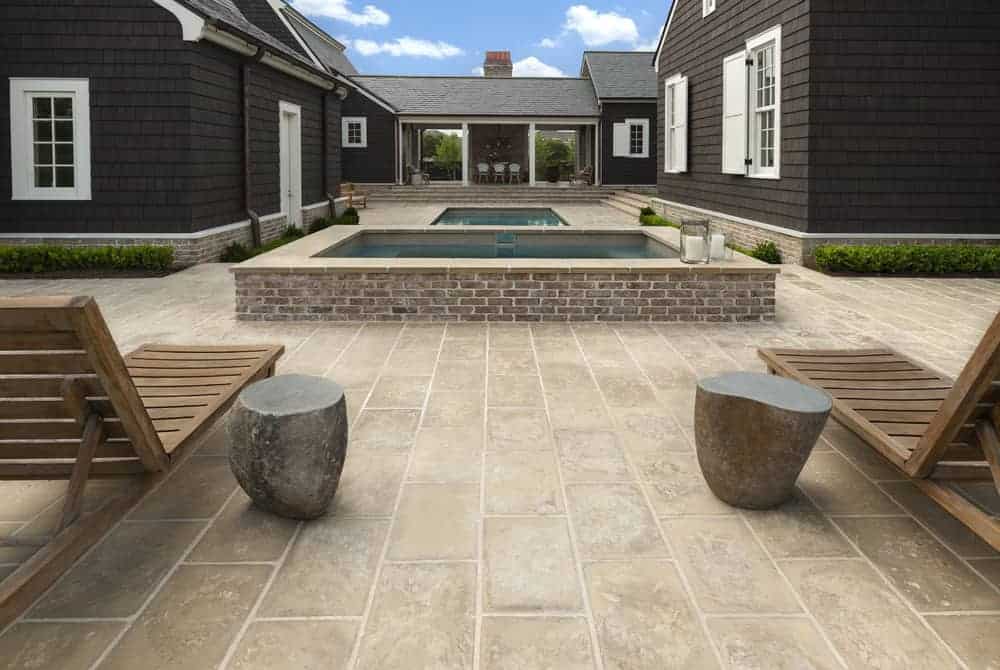
A pool deck has to do more than look good. It has to perform under bare feet in direct sun, stay safe when wet, and hold up to years of sunscreen, pool chemicals, and constant foot traffic. Getting the paver selection right is one of the most consequential decisions in the entire pool design process.
Here’s how to think through heat, slip resistance, and style when choosing pavers for your pool deck, and how those three factors work together rather than against each other.
Why Heat Matters More on a Pool Deck Than Anywhere Else
Few outdoor surfaces get walked on barefoot the way a pool deck does. That makes heat retention one of the most important performance factors to evaluate, and one that’s easy to overlook until the first scorching afternoon makes it impossible to ignore.
Several factors influence how hot a paver gets in direct sun:
- Color: Darker pavers absorb more solar energy and run hotter than lighter colors. A deep charcoal paver can be measurably hotter underfoot than a light buff or oyster tone in the same direct sun
- Surface finish: Smooth, dense finishes tend to retain and radiate more heat than textured surfaces, which scatter light and create more surface area to dissipate warmth
- Material density: Concrete pavers generally stay cooler than natural stone alternatives like dark granite, and certain paver formulations are specifically engineered to reduce heat absorption
For pool decks in particular, lighter color families, such as Rice White, Oyster, and Champagne, are popular choices precisely because they stay significantly cooler underfoot than darker tones. If you’re drawn to a darker palette for aesthetic reasons, a textured or tumbled finish can help offset some of that heat retention, though color remains the single biggest factor.
Slip Resistance: The Non-Negotiable for Pool Decks
A pool deck is wet more often than it’s dry. Splashing, dripping swimmers, rain, and irrigation all mean the surface needs to perform safely when wet, not just when dry. This is where finish selection becomes critical.
Finishes Built for Wet Conditions
Smooth, polished finishes look beautiful, but they’re the wrong choice for a pool deck surface that will regularly be wet. The most effective finishes for pool deck slip resistance include:
- Tumbled finishes, which create a softened, irregular surface texture that provides natural grip even when wet
- Exposed aggregate finishes, which reveal the stone and mineral content within the paver, create one of the most slip-resistant surfaces available. The texture grips reliably even in fully saturated conditions
- Brushed and sandblasted finishes, which open up the surface texture for added grip while maintaining a more refined, contemporary look than a heavily tumbled or aggregate finish
Smooth finishes should generally be avoided in zones immediately adjacent to the water, or reserved for covered areas where wet conditions are less frequent. If a smooth finish is part of your overall design vision, consider pairing it with a grip-enhancing sealer or limiting it to areas set back from the splash zone.
Balancing Heat, Slip Resistance, and Style
The good news is that heat management and slip resistance often point in the same direction. Textured finishes, which provide better grip, also tend to run cooler than smooth, dense surfaces because the irregular surface disperses heat more effectively than a flat, glossy plane.
This means the safest choice for a pool deck is frequently also the most comfortable one underfoot. A light-colored, tumbled, or exposed aggregate paver checks both boxes: cooler in direct sun and reliably grippy when wet.
Where style comes in is choosing within that performance-driven framework. A tumbled finish in a warm buff or champagne tone delivers an old-world, resort-style aesthetic. An exposed aggregate finish in a cooler dolphin grey or slate tone reads as more contemporary and architectural, while still delivering excellent slip resistance.
Pool Deck Color Selection
Beyond heat performance, color affects the overall feel of your pool area. A few considerations worth weighing:
- Light colors (Rice White, Oyster, Champagne) create a bright, expansive feel and reflect more light back up around the pool, which many homeowners find enhances the sense of openness around the water
- Warm neutrals (Buff, Champagne) read as natural and earthy, pairing especially well with tumbled or textured finishes for a resort-inspired aesthetic
- Cool neutrals (Dolphin Grey, Slate) create a more architectural, contemporary feel, particularly effective with large-format pavers and exposed aggregate or brushed finishes
Whatever color family you choose, remember that pavers darken noticeably when wet, which is worth factoring into how a color will actually read around a pool that’s in regular use.
Pool Deck Size Considerations
Large-format pavers have become the standard for high-end pool decks, and for good reason. Sizes in the 23.5 by 23.5 inch and larger range create an expansive, gallery-like surface with fewer grout lines, which reads as calmer and more luxurious around the water. Fewer joints also means fewer opportunities for weeds, settling, or surface irregularities over the life of the installation.
For pool decks with more traditional or transitional design intentions, a mixed-size installation combining two or three complementary sizes adds visual richness while still delivering the same heat and slip performance benefits.
Get the Right Pavers for Your Pool Deck
Choosing pool deck pavers is one of those decisions that benefits enormously from seeing and feeling the material in person, in real outdoor light, ideally on a warm day. Peacock Pavers’ handcrafted concrete pavers offer the color, finish, and size range to build a pool deck that’s beautiful, safe, and comfortable underfoot for years to come.
Browse our exterior and landscaping pavers, explore real installations in our gallery, or order a sample kit to evaluate heat and texture firsthand before you commit. You can also contact our team to talk through your specific project.